
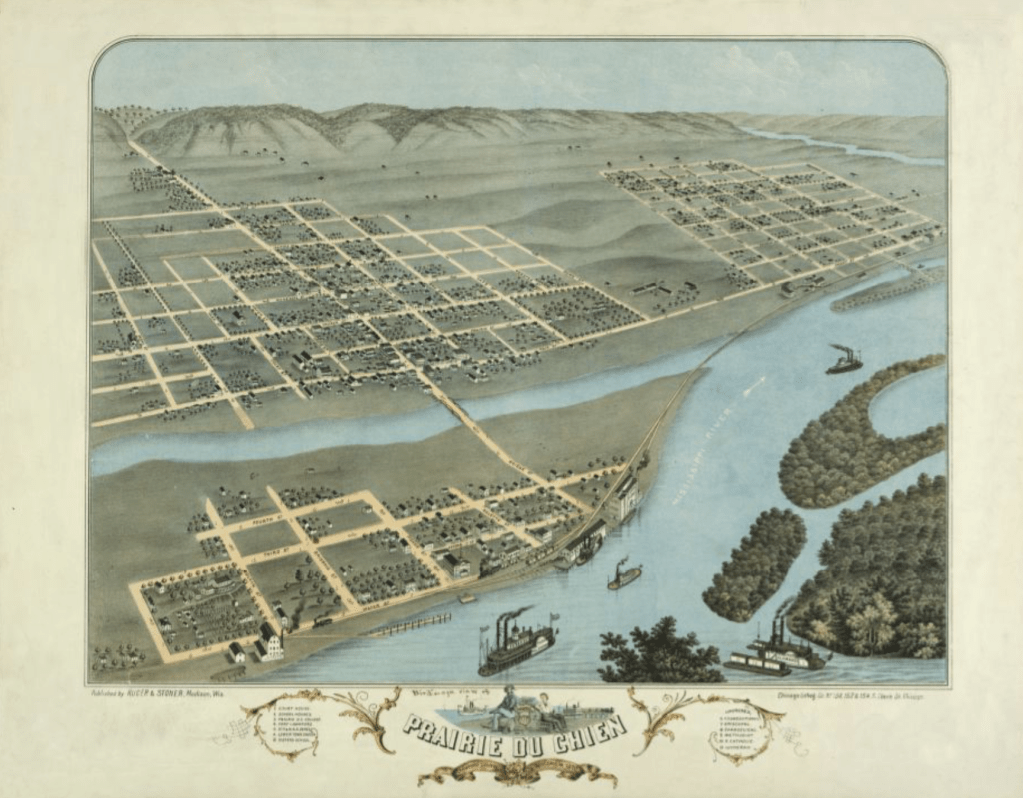
If you recall from our last post, we mentioned how Prairie du Chien is the second oldest city in Wisconsin. Top honors of course belong to Green Bay, but Prairie du Chien’s 350+ years is nothing to scoff at. PDC is actually the 4th oldest city in the entire midwest, behind GB, Sault Ste. Marie (MI), and St. Ignace (MI). While normally these posts would cover the geography and geology of the area in addition to its history, we’ll save the geo stuff for a Driftless area post. Which means lucky you, you won’t be forced to read for more than 5 or so minutes. OH THE HUMANITY!!! HOW WILL YOU EVER SURVIVE?? Sarcasm aside, I hope you get something out of this.
Let’s start with some basic facts. Modern Prairie du Chien was first established by French Voyagers in 1673. Prior to that, it was most likely also used as a trading site for various Native American tribes. Jaques Marquette and Louis Joliet were looking for a route to the Mississippi River from Lake Michigan, and after connecting from the Fox and Wisconsin Rivers, they finally found it here. With the fur trade being as big as it was in this area, a trading post was eventually established at PDC. While the fur trade ebbed and flowed throughout the centuries, PDC remained the center of the fur trading world until about the mid 1800’s, when animal numbers started to go down (an unfortunate bit of our history as well) and demand fell in Europe.
The name “Prairie du Chien” is clearly French in origin, and translates directly to “prairie of the dog” or “dog meadow”. When the French voyagers first met the natives here, they met a Fox tribe chief whose name was “Alim”, which in French means chien… dog.
Obviously Wisconsin wasn’t a state until 1848, but for a long period of PDC’s history, it wasn’t even part of America itself. Before the French and Indian War, present day Wisconsin was part of French territory. At the conclusion of that war, around 1763, Great Britain took over the territory, adding it to their lands in the eastern portion of the continent. And then came 1776… and we all know what happened then. FREEDOM BABY!! USA! USA! USA! What’s that England? You like tea? We don’t, but we do like to flavor our harbors with a side of tea!!! USA!!! Anyways, ‘Murica won all land east of the Mississippi, including present day WI. But… not so fast, as it appears Great Britain didn’t exactly honor their end of the deal 100%. They pulled out of the eastern territories very slowly. So slowly, in fact, that it wasn’t really truly American, or governed by America until after the War of 1812.
But wait just one minute! It still wasn’t ours just yet. During the War of 1812, the British still held onto Canada, and the US, fearing an invasion through Canada, constructed a fort at PDC, calling it Fort Shelby. However, in 1814 the British captured it, and held on to PDC until the wars end. At the conclusion of the war, the US realized the strategic location of PDC and constructed Fort Crawford. Fort Crawford has its own rich history afterwards, one worth exploring, but we’re going to focus on the larger picture of Prairie du Chien for todays post.
The fur trade continued to dominate the areas economy until the mid 1800’s. When the fur trade ended, agriculture and rail commerce took over as the de-facto economic driver, but it would never be as commercially important as it was during the height of the fur trade. Railroads were starting to dominate the way goods travelled, leaving PDC high and dry when it came to the importance of moving goods. With river travel competing with rail travel, the bigger cities in the midwest started to slowly become connected via rail. PDC’s location, while once the reason for its importance, took a backseat. While it is still a (relatively – for WI) major port on the Mississippi, it is no longer the hub it once used to be.
In an effort to wrap this up in a timely manner, I do feel like a few other major things of note should be mentioned. First, the main island off of the mainland of Wisconsin is called Saint Feriole Island. This is actually where the first parts of the city were. The fur trade happened here, Fort Shelby was here, the only battle of the War of 1812 in WI happened here… the people lived here before they lived on the actual land of WI. But the Mississippi River is a fickle mistress, and she tends to flood when she pleases. Decades of losing land and property, with a finality of the flooding of 1965 finally forced the islands inhabitants to the mainland, where the city has been ever since. Lastly, as a science nerd I would be remiss if I didn’t say at least one sentence of the geography and geology (which I said I wasn’t going to do but it turns out I lied). Prairie du Chien is located in the Mississippi River Valley, which for all intents and purposes means the city is bound by two rivers and some bluffs, occupying the relatively flat land in between the two. And last but not least, there is a layer of sedimentary dolomite rock that dominates western Wisconsin, and it is has been named after the city, Prairie du Chien Dolomite.
I’m new to this whole blogging thing, and I found some pretty awesome pictures to go along with this post. However, I’m still in the *figure out how to get permission phase/realize how long it takes to get permission phase* when it comes to getting access to putting these awesome pictures in my posts. Wisconsin Historical Society has some great pictures, and I highly recommend that if you’re interested in going there and checking it out. Hopefully the next time I do a history post I’ll have that all figured out for you guys. In the meantime, you’ll have to settle for my poorly worded blogs. So, if you’re a history buff, a Wisconsin buff, a travel buff, or some combination, I hope you do at some point make it to Prairie du Chien!

 Life is Too Short to Take the Fast Way